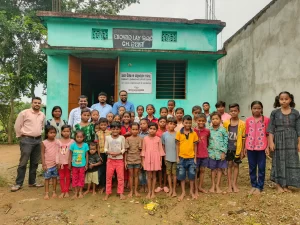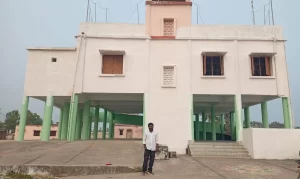
Recently, I had the privilege of visiting a community learning and support center run by Youth for Social Development (YSD) in the IAY colony of Ch. Nuagaon village, located in Odisha’s Ganjam District. What I witnessed during this short visit was a testament to the power of community-led efforts in transforming the lives of children in marginalized spaces—spaces often overlooked by formal institutions and policy frameworks.
To understand the importance of such a center, it is essential to understand the history and social context of the IAY colony itself. This settlement is home primarily to Dalit families who, in the 1980s, were forcibly ostracised from the main village roughly 5 kilometres away. The dispute that triggered their exclusion revolved around their access to a community well, which the upper caste residents refused to share. Over the years, this act of segregation became normalized, and the colony has remained socially, economically, and geographically isolated from the main village.
The physical remoteness is reinforced by poor infrastructure. The colony has no paved roads leading in or out. A 2-kilometer mud path through farmlands is the only link to the main road. This path becomes almost impossible to traverse during the monsoons when the fields flood and the ground turns to slush. For residents, particularly for children and the elderly, even basic mobility becomes a challenge during these months.At one point, a primary school was opened within the colony to cater to its children. But even that lifeline was cut off during the COVID-19 pandemic, when a nationwide policy push for “school rationalisation” recommended the closure of schools with low enrollment. The school in IAY colony, with fewer than 20 students, fell into that category. The idea was to merge smaller schools into larger institutions, presumably offering better infrastructure and teaching quality. In practice, for children here, it meant walking over an hour each way to reach the nearest school in Ch. Nuagaon—a journey across uneven farmland, often through marshy and slippery terrain.
This trek is gruelling on a regular day and becomes hazardous during the rainy season. Not surprisingly, many children began to miss school frequently, some staying home for up to 10 days each month during the monsoons. And yet, they show up at the community center every day.
It is against this backdrop that YSD’s intervention must be understood. Their community learning center is more than just a tutoring space. It’s a critical support system that gives these children a fair shot at continuing their education. The center runs remedial sessions from 4 to 6 PM on weekdays and holds longer sessions of around three hours over the weekends. The goal is not only to help children catch up with what they’re missing at school but also to create a joyful, safe, and engaging environment that encourages learning and curiosity.
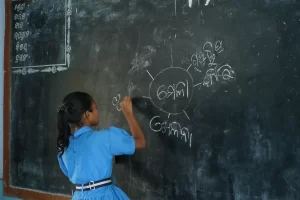
YSD refers to these centers as Khela Vatikas—a phrase in Odia that translates to “garden of play.” And it truly is that. During my visit, I was joined by Mr. Bibhu, YSD’s Secretary, and a few members of their team. We arrived to a heartwarming welcome, with the children greeting us with handmade bouquets and beaming smiles. There was a sense of excitement in the air, something you rarely encounter in typical classroom settings.The class was in full swing when we entered. The instructor was a young volunteer from a nearby village. She had arranged the children in a circle and continued the session. There were around 30 students, ranging from standard 2 to standard 8. Despite the range in ages and learning levels, the atmosphere was inclusive and participatory. Lessons were being taught not through rote memorisation but through games, storytelling, and activities.For example, basic literacy and numeracy were taught using gamified techniques that made it easier for younger children to grasp concepts. The children were also taken on walks around the colony to observe plants and animals, making learning tangible and rooted in their immediate environment. Life skills and value education were embedded seamlessly into these sessions, sometimes through stories, other times through group discussions and role-play.
What struck me most was the sense of ownership and community within the center. The children weren’t just passive recipients of knowledge; they were active participants. They voiced their thoughts, asked questions, and helped each other. They talked about how school often felt distant and mechanical, centred around what the teacher said or wrote on the board. The center, in contrast, was a space of “doing”of applying what they learned, of making sense of it through action.Several children admitted that they only continued to go to school because of what they learned at the Khela Vatika. It gave them the confidence and foundational skills to keep up with their formal curriculum. It was clear that for many of these children, the centre had become a second school, if not the primary one, in terms of actual impact.
YSD currently runs more than 15 such centers across the district. Each is tailored to the needs of its specific community but grounded in the same principles: inclusivity, joy, empowerment, and community engagement. The organisation works with local volunteers, many of whom are young people from neighbouring villages, thereby building a network of grassroots educators and mentors.
The implications of this work go far beyond academic learning. These centers help bridge the social and psychological gaps that children in excluded communities often experience. They foster a sense of belonging, of being seen and valued. They challenge the dominant narrative that only formal institutions can deliver meaningful education. And perhaps most importantly, they restore a child’s right to dream.
As I left the center that day, I found myself reflecting on what true education looks like. It’s not always about fancy classrooms or digital tools. Sometimes, it’s a volunteer with a chalkboard, a group of excited children in a circle, and the determination of a community that refuses to let its next generation be left behind.
In a small Dalit colony, tucked away from paved roads and mainstream policy attention, a garden of learning is quietly blooming—and it is beautiful.
Dr. Namesh Killemsetty is an Assistant Professor in the Jindal School of Government and Public Policy at O.P. Jindal Global University, India. He completed his Ph.D. in Public Policy from the University of Massachusetts Boston in 2021. As a transdisciplinary researcher working in urban governance and poverty, Namesh’s work particularly focuses on integrating theories and methods from Urban Studies, Policy Analysis, Operations Research, and Decision Sciences.His research is supported by his previous training in Infrastructure Management and Civil Engineering. Namesh is the recipient of the 2021 Urban Affairs Association Alma H. Young Emerging Scholar Award, USA and has been a global winner in a competition on Research in Urban Development by Woodrow Wilson International Center for Scholars, USAID, and the World Bank Group.